

When choosing a cat scratching post, many people might consider the material and design, but perhaps fewer pay attention to the size. However, recent veterinary research reports that the size of a scratching post is more involved in how a cat uses its body than previously thought.

Scratching is also a full-body exercise
What is a cat doing when it scratches? It's often thought that they are just shedding old nail sheaths, but reading veterinary behavioral literature reveals a slightly different perspective.
A review paper by DePorter and Elzerman published in a veterinary behavioral journal in 2019 lists "removal of the outer nail sheath," "exercise of the forelimb and spinal muscles," and "promotion of stretching" as functions of scratching. For cats, scratching appears to be both nail care and a full-body exercise.
Scratching and stretching are also discussed in other papers
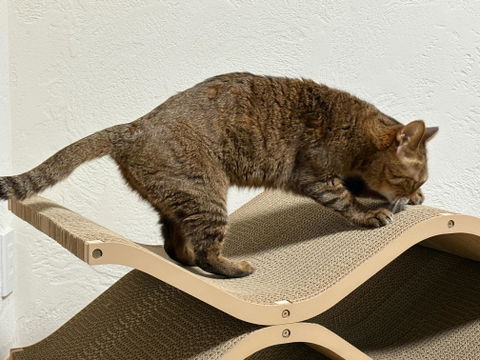
An Italian research team (Mengoli et al., 2013) states something similar. Their paper describes scratching as an action that "stretches the body and strengthens the muscles and tendons involved in claw extension and retraction." Pushing off with their hind legs, arching their backs, and extending their front paws as far as possible—that coordinated movement from the shoulders to the spine and hind legs is a cat's way of doing a full-body stretch.
Size matters. If a scratching post is too small, a cat cannot fully extend its body. It will adopt a cramped posture, only moving its front paws a little, and the effect as a "stretch" will be halved.
The 90cm turning point
Wilson et al.'s 2016 study extensively investigated the relationship between scratching post size and cat behavior. This research, which gathered responses from 4,331 cat owners in 39 countries, yielded interesting results. Cats using scratching posts taller than 3 feet (approximately 90cm) were about 10% less likely to scratch furniture or other inappropriate places.

The 90cm figure is close to the height at which many adult cats can fully extend their bodies when standing on their hind legs and stretching their front paws. It seems that if there was a scratching post where they could stretch their bodies to their full extent, there was no longer a need to use sofas or walls. If there's a cat in the house that "ignores" its scratching post, it might not dislike it; it might just be the wrong size. This perspective changes how we see things.
A survey by Moesta et al. (2018) also found that 72.6% of cats prefer vertical scratching posts. They choose items that allow them to stretch their bodies vertically over those placed flat on the floor. This is because scratching functions not just as nail care but as a full-body exercise, naturally leading them towards shapes that make it easy to stretch.

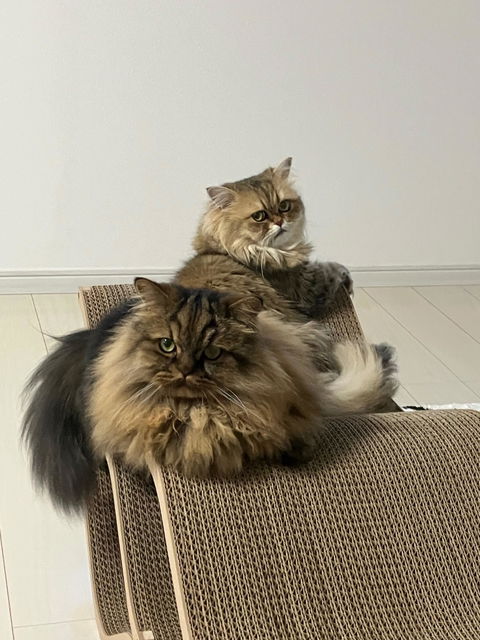
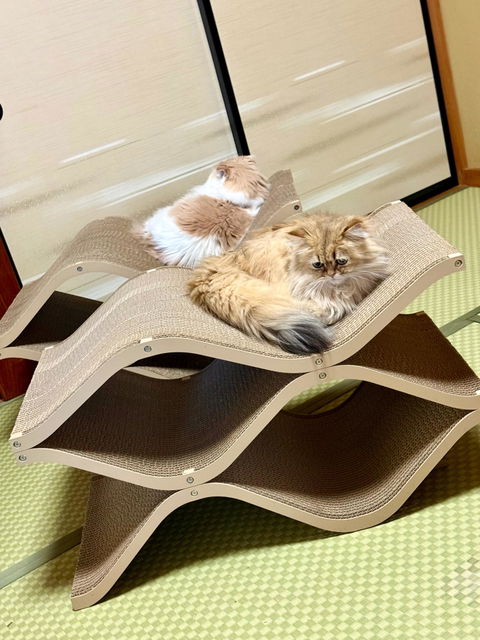
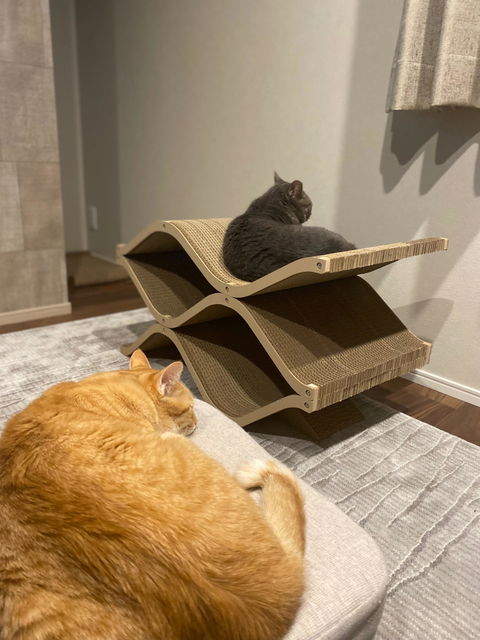
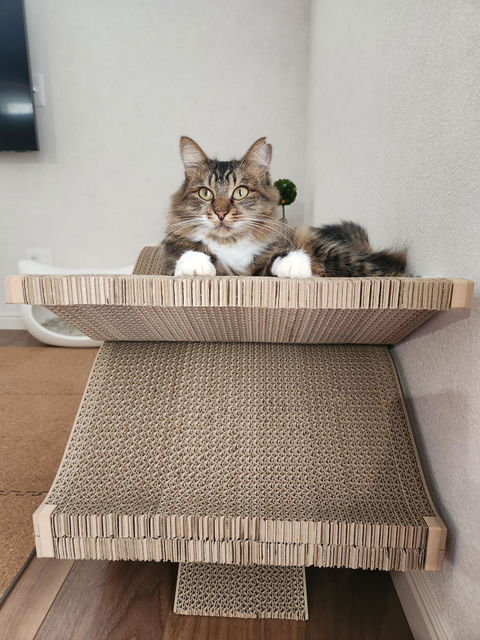
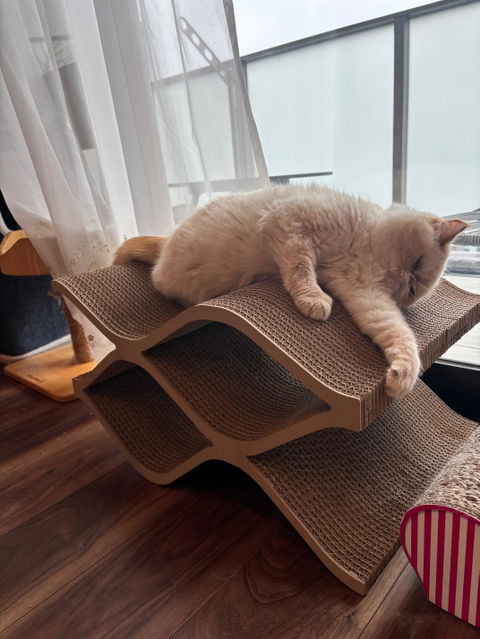
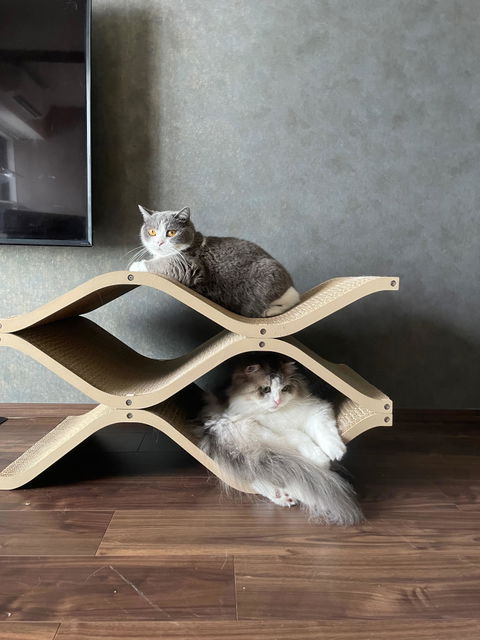
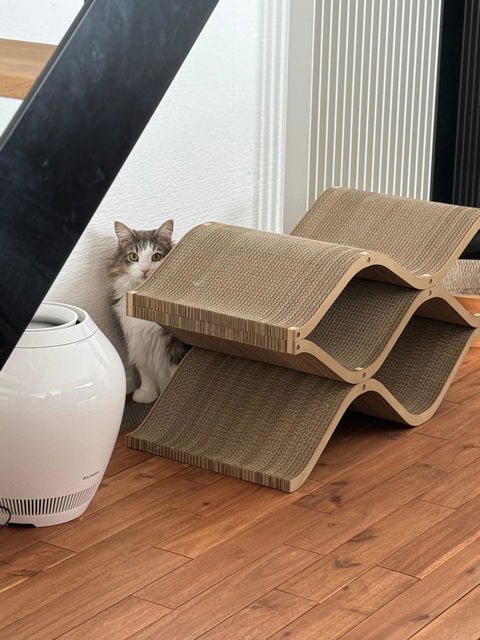
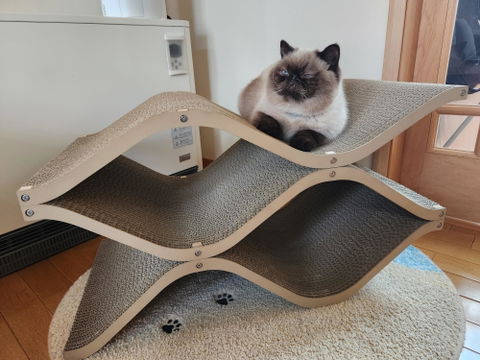
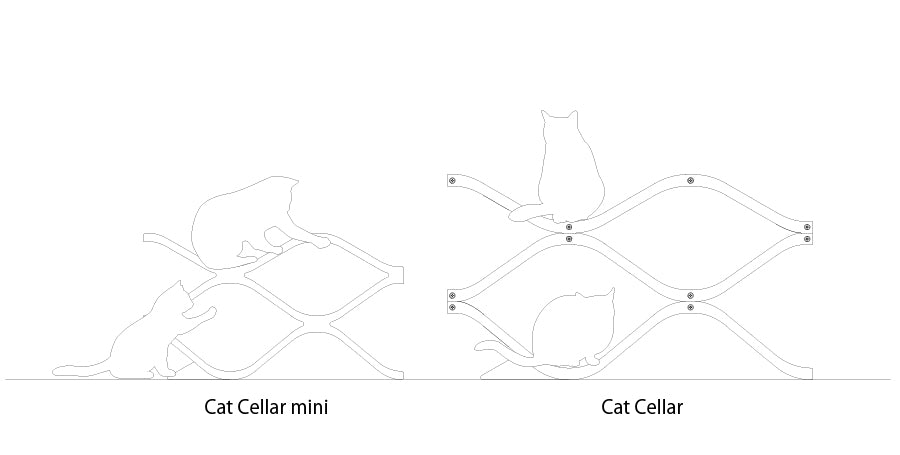
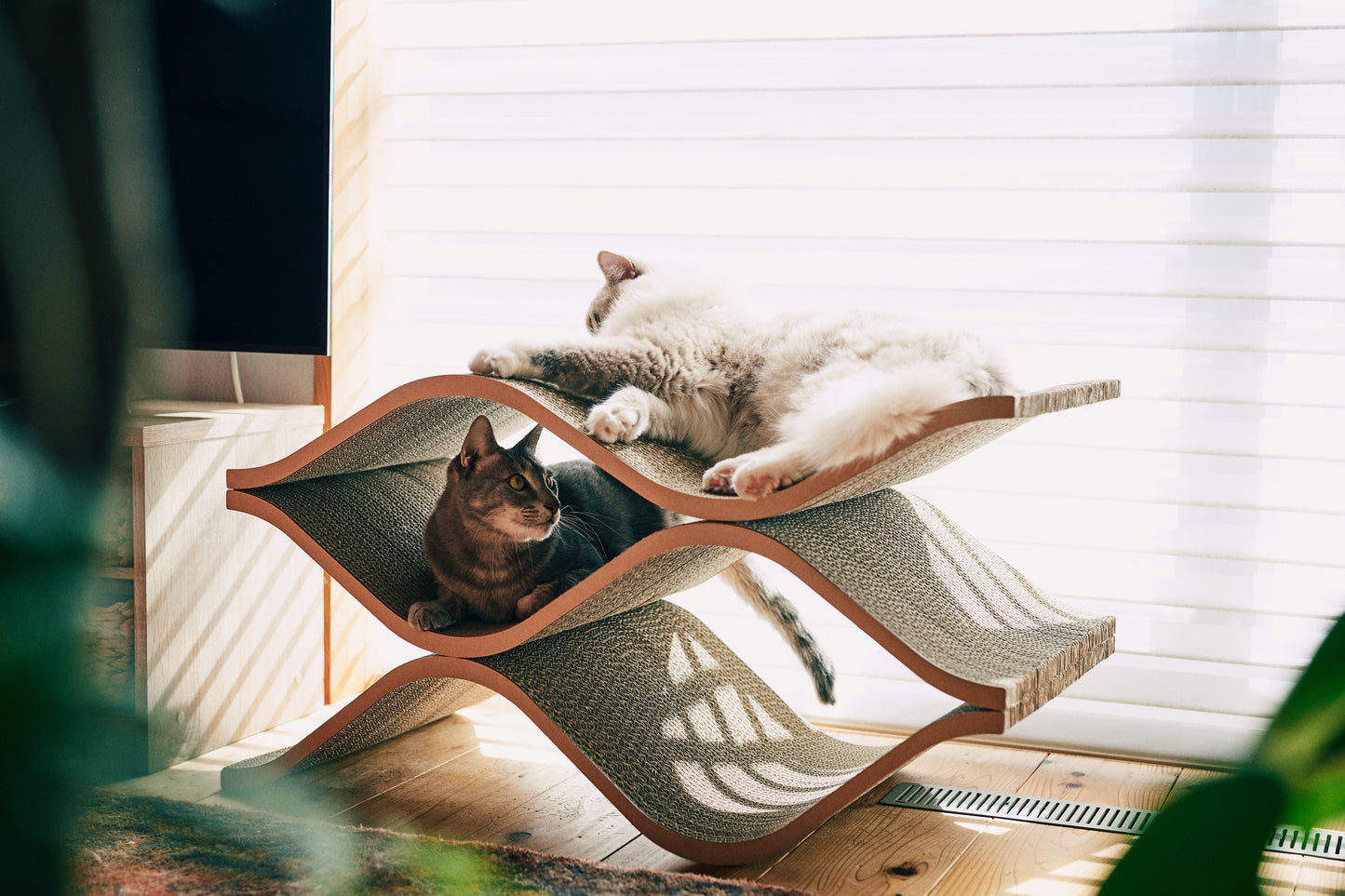
Cat Cellar is a large interior scratching post, 80cm wide and 40cm deep, designed with an S-shaped wave structure that allows cats to lean into it and stretch. Although it doesn't quite reach the 90cm mentioned in the text, stretching along the curved part makes it approximately 1m. Its unique feature is not just its height, but the wide surface area provided by the curves for stretching the body. When choosing a scratching post, paying a little attention not only to the material but also to the size and shape might lead to a better choice for your cat's body.
If you have any questions about how to use it, please feel free to send us a message via our official LINE account. Our customer service staff will be happy to answer you.
*References: Wilson C, Bain M, DePorter T, et al. Owner observations regarding cat scratching behavior: an internet-based survey. Journal of Feline Medicine and Surgery, 2016. DOI: 10.1177/1098612X15594414 / DePorter TL, Elzerman AL. Common feline problem behaviors: Destructive scratching. Journal of Feline Medicine and Surgery, 2019. DOI: 10.1177/1098612X19831205 / Mengoli M, et al. Scratching behaviour and its features. Journal of Feline Medicine and Surgery, 2013. DOI: 10.1177/1098612X13481468 / Moesta A, Keys D, Crowell-Davis S. Survey of cat owners on features of, and preventative measures for, feline scratching of inappropriate objects. Journal of Feline Medicine and Surgery, 2018. DOI: 10.1177/1098612X17733185









![[10%off] Cat Cellar & Cat Cellar mini set](http://furnya.myshopify.com/cdn/shop/files/ChatGPT_Image_2026_7_14_10_47_09.png?v=1784117296&width=1445)
![[10%off] Cat Cellar & Cat Cellar mini set](http://furnya.myshopify.com/cdn/shop/files/ChatGPT_Image_2026_7_22_13_58_41.png?v=1784696340&width=1445)
![[10%off] Cat Cellar & Cat Cellar mini set](http://furnya.myshopify.com/cdn/shop/files/custome.png?v=1784660252&width=1445)
![[10%off] Cat Cellar & Cat Cellar mini set](http://furnya.myshopify.com/cdn/shop/files/a6e833342526f732049771ddbb636dc4.png?v=1787552594&width=1445)
![[10%off] Cat Cellar & Cat Cellar mini set](http://furnya.myshopify.com/cdn/shop/files/ChatGPT_Image_2026_8_24_15_27_00.png?v=1787552842&width=1445)
![[10%off] Cat Cellar & Cat Cellar mini set](http://furnya.myshopify.com/cdn/shop/files/ChatGPT_Image_2026_8_24_15_31_55_010ef098-0a26-4fb7-98d5-51d506349356.png?v=1787553188&width=1445)