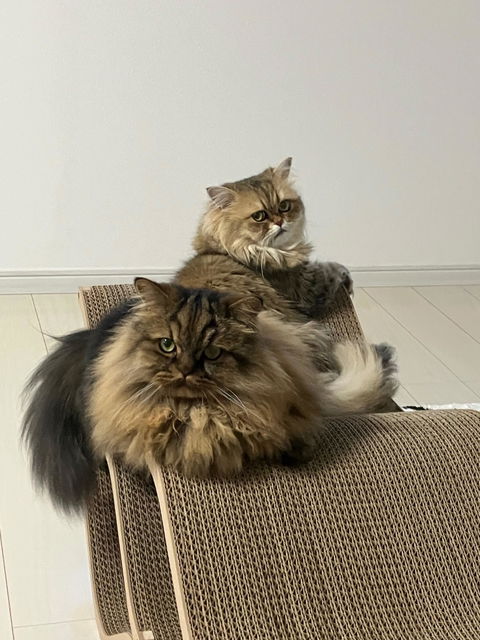
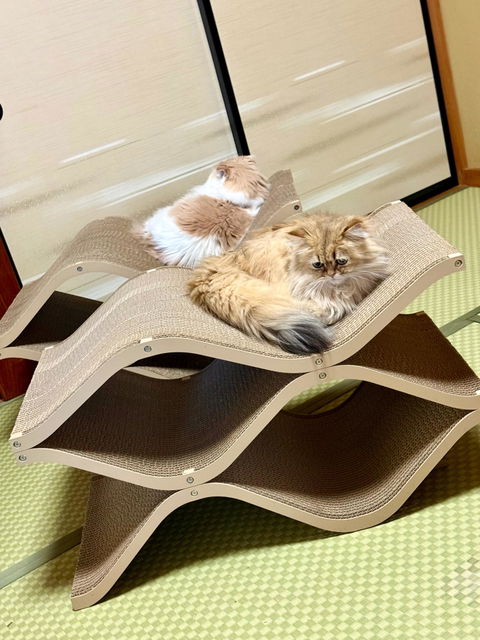
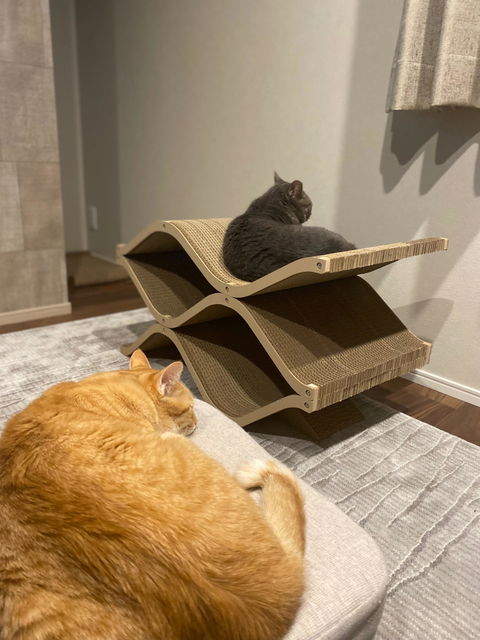
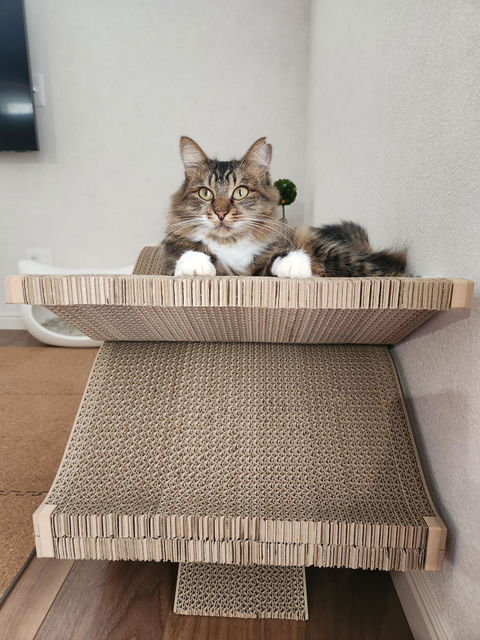
Scratching posts are essential for living with cats.
If you're thinking about living with a cat, or have just started, you might not know much about scratching post habits.
Even if you already live with a cat, many people feel they're replacing scratching posts too often, or that their cat isn't using the one they bought.
We conducted a survey on scratching posts to gather data on what people really want to know!
Survey Overview (n=92)
Date: January 17, 2026
Target: General cat owners (conducted via CrowdWorks)
Questions asked:
① Type of scratching post used (multiple answers allowed)
② Number of each type owned
③ Frequency of use for each type (total 100%)
④ Average replacement frequency
⑤ Purchase location
⑥ Issues (free response)
*The numerical values in this article are a compilation of responses. Please note that they are a guideline, as results may vary depending on the cat's personality, physique, and environment.
Scratching Post Replacement Frequency: Most Common is "Every 2-3 Months"
The distribution of responses (n=92) was as follows:
| Replacement Frequency | Number of People | Percentage |
|---|---|---|
| Every 2-3 months | 43 | 46.7% |
| Until worn out (1 year or more) | 17 | 18.5% |
| About every 6 months | 16 | 17.4% |
| More than once a month | 9 | 9.8% |
| About once a year | 7 | 7.6% |
Roughly half of respondents replaced them "every 2-3 months," while nearly 20% used them for a longer period (1 year or more). This result shows that the replacement frequency tends to vary depending on the number of cats, how they scratch, and how many scratching posts are available.
Assuming a typical scratching post costs around ¥3,000, this calculates to approximately ¥20,000 per year.
What scratching posts are people using? (multiple answers)
Looking at "what is being used," cardboard was clearly the main player.
- Cardboard: 75 people (81.5%)
- Rope (e.g., hemp): 34 people (37.0%)
- Fabric: 17 people (18.5%)
- Other: 1 person (1.1%)
Furthermore, the average (n=92) of "how much is actually used as a percentage of the total 100%" was:
- Cardboard: Average 66.0%
- Rope (e.g., hemp): Average 19.6%
- Fabric: Average 11.1%
- Other: Average 0.8%
This suggests that even if multiple types are owned, cardboard tends to be the most commonly used for daily scratching.
How many cardboard scratching posts do you have at home? (More than half have "multiple posts")
The number of cardboard scratching posts owned by those who use them (n=75) was as follows:
- 1: 36 people (48.0%)
- 2: 27 people (36.0%)
- 3: 7 people (9.3%)
- 4 or more: 5 people (6.7%)
Approximately 52% have two or more. Many households seem to be distributing stress by placing multiple posts, such as "placing them along the cat's path" or "placing them in each room."
Where do you buy them? The top choice is "online retailers (major marketplaces)"
Here's a breakdown of purchase locations (n=92).
- Online retailers (major marketplaces): 35 people (38.0%)
- Pet stores: 24 people (26.1%)
- Home centers and other mass retailers: 23 people (25.0%)
- Online retailers (individual manufacturers/brands): 6 people (6.5%)
- Other: 4 people (4.3%)
The results show that purchases from major marketplaces like Rakuten and Amazon are common. Half of all respondents also make offline purchases at pet stores or home centers.
[Issues] Top concern is "shavings and cleaning," second is "durability"... and "safety" has also increased
When the free responses (67 entries) were roughly categorized:
-
Shavings/cleaning-related: 40 entries (approx. 59.7%)
Examples: messy / scattered / difficult to clean / fibers and paper scraps on the floor -
Durability/wear-and-tear-related: 26 entries (approx. 38.8%)
Examples: quickly worn out / wears down fast / big difference in longevity -
Safety/paw concerns: 16 entries (approx. 23.9%)
Examples: worried about ingestion / claws splitting or getting caught / painful claws / worried about floor getting scratched
There were also a small number of other comments:
- Cat doesn't use it / scratches furniture: 9 entries (approx. 13.4%)
- Moves / want to fix it: 5 entries (approx. 7.5%)
- Trouble disposing: 3 entries (approx. 4.5%)
- Appearance / placement: 2 entries (approx. 3.0%)
In summary, the main concerns are still "shavings" and "durability," with "safety (ingestion, claws, floor damage)" now also a significant concern.
It's easier to decide when to replace based on "signs" rather than "months"
While "2-3 months" is the most common, it varies greatly depending on how your cat scratches and their environment.
Therefore, it's recommended to decide on replacement based on "replacement signs" rather than a fixed number of months.
Time to replace if:
- They don't seem to enjoy scratching it (shallow scratching / slipping)
- The amount of shavings suddenly increases
- The edges are peeling, causing concern about ingestion (especially for cats who tear and eat with their mouths)
- It wobbles or moves (making it difficult to scratch and potentially causing them to switch to furniture)
- Odor or dirt is noticeable
Easy steps for "shavings & cleaning" starting today!
The number one concern is the shavings problem. This is where you can make quick improvements.
-
Create a "catch tray": Place a mat, newspaper, or large sheet under the scratching post.
→ This makes cleanup much easier. -
Change the order of cleaning: Use a lint roller (or broom) first, then vacuum.
→ This prevents scattered paper scraps from flying around. -
Fix the placement: Avoid scattered areas (like the center of the living room) and move to a zone that's easy to clean.
→ Simply reducing "visible clutter" lowers perceived stress.
"Quickly worn out" can be remedied by "placement"
While durability varies by product, how you place it often affects its lifespan.
-
Rotate the scratching surface (change direction / flip upside down)
→ Prevents only one corner from being worn down -
Place it in traffic areas + secure zones (frequently used areas, calming spots)
→ Can reduce scratching on furniture -
Use non-slip pads for moving issues (e.g., non-slip rug pads)
→ Helps reduce "moving → difficult to scratch → scratching elsewhere (furniture)"
Mini solutions for the increased "safety concerns" (ingestion, claws, floor damage)
- Concerned about ingestion: Replace early if peeling or thin layers appear / clean only the surrounding area frequently (especially for cats who eat it)
- Claws hurt/get caught: The roughness (hardness) or material may not be suitable → even with cardboard, responses can vary with "harder/softer" types
- Worried about floor damage: Non-slip bottom + protective mat (even thin felt is effective)
- Large cat damaging walls or floor: Choose a type with sufficient "height/length" for their size (a length that allows them to stretch fully can reduce furniture scratching)
What furnya's Cat Cellar aims to be
This survey revealed the reality that:
- Most people use cardboard (81.5% of users)
- Replacement is most frequent at 2-3 months (46.7%), with an annual expenditure of about ¥20,000.
- The overwhelming concerns are "shavings" and "durability"
- Furthermore, there are many safety concerns, such as "ingestion, claws, and floor damage."
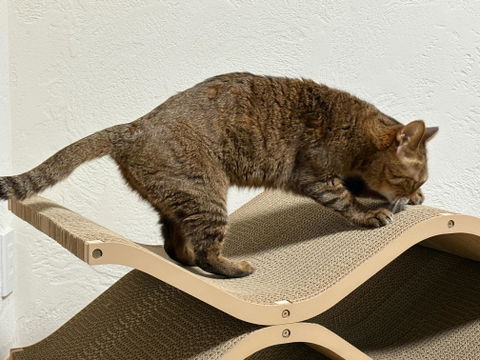
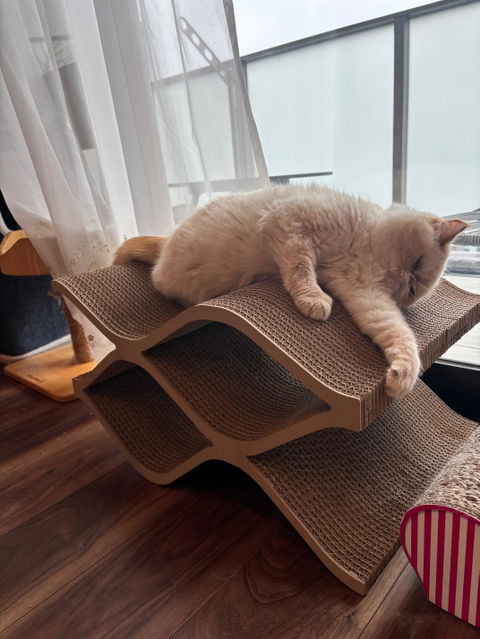
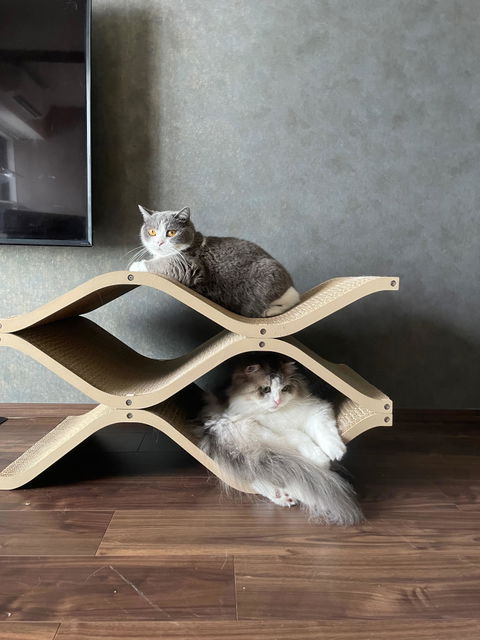
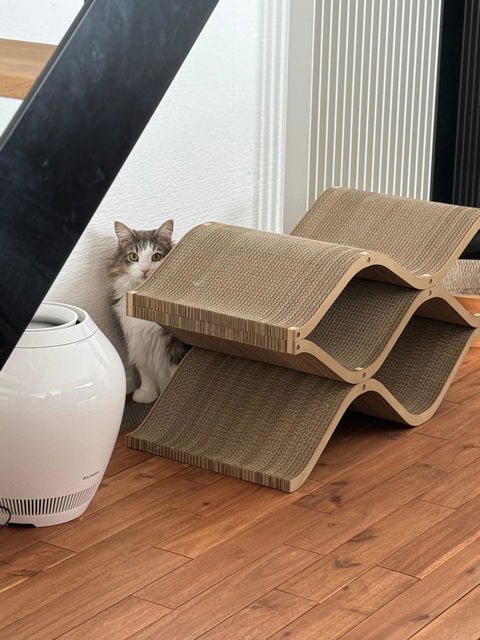
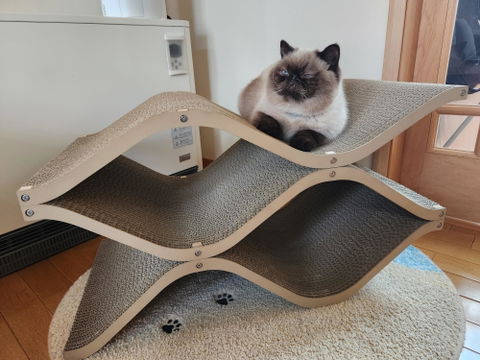
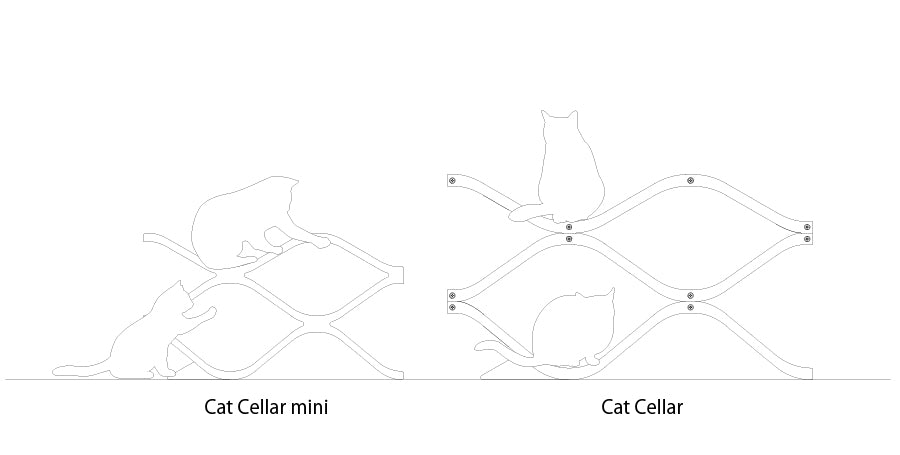
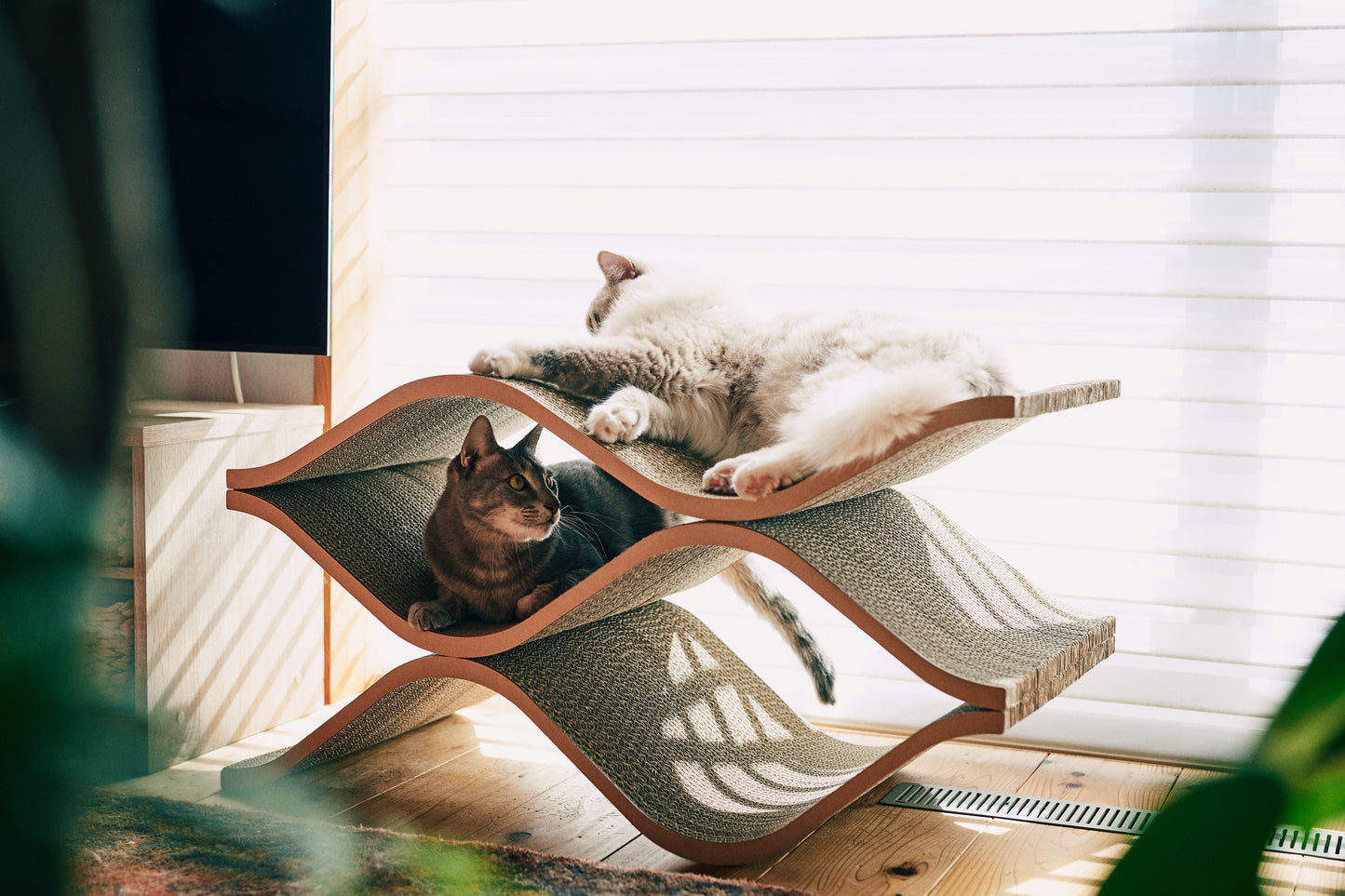
furnya's Cat Cellar uses high-strength cardboard compared to regular scratching posts. It aims to address these real-world problems by providing a comfortable scratching experience for cats while also minimizing household stress (clutter, appearance, placement).

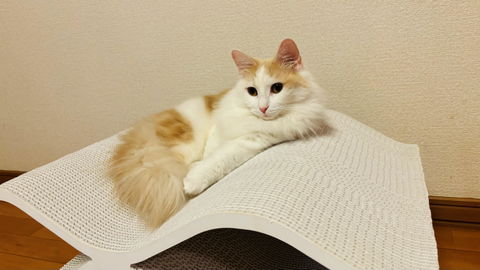
Not only can it be used for a long period of time beyond its price, but it also creates a pleasant space for cats with curves and tunnels that cats love, all within a beautiful design. Of course, it also blends beautifully into any interior as a decorative item.
It's also common to buy something only for the cat not to use it. The Cat Cellar also has a strong aesthetic quality, making it a beautiful interior piece to have in a space.
Sometimes cats are just wary at first, and many people have found that their cats start using it after leaving it out for a while or changing its location. We hope that for such people, even the "waiting" period can be enriching.
Summary: Most common is "2-3 months." But the right answer is determined by "your cat's signs."
- The most common replacement frequency is once every 2-3 months (46.7%).
- Concerns primarily revolve around shavings and cleaning, and durability (mentioned in many of the 67 free responses).
- This time, concerns about safety, such as ingestion, claws, and floor damage, were also prominent.
- It's less likely to go wrong if you judge by replacement signs rather than "months."
How often do you replace your scratching post at home?
The ideal replacement frequency varies by household and by cat. We hope this survey can serve as a guide and reference.


![[10%off] Cat Cellar & Cat Cellar mini set](http://furnya.myshopify.com/cdn/shop/files/ChatGPT_Image_2026_8_24_15_31_55_010ef098-0a26-4fb7-98d5-51d506349356.png?v=1787553188&width=1445)